Music Generation, MusicGen, Stable Audio, Suno, and the Licensing Earthquake
2026 music generation: Suno v5 and Udio v4 dominate commercial; MusicGen, Stable Audio Open, and ACE-Step lead open-source. The technical problem is mostly solved. The legal problem (Warner Music $500M settlement, UMG settlement) reshaped the field in 2025-2026.
The Problem
Text → a 30-second to 4-minute music clip, with lyrics, vocals, and structure. Three sub-problems:
- Instrumental generation. Text like "lo-fi hip-hop drums with warm keys" → audio. MusicGen, Stable Audio, AudioLDM.
- Song generation (with vocals + lyrics). "Country song about rainy Texas nights" → full song. Suno, Udio, YuE, ACE-Step.
- Conditional / controllable. Extend an existing clip, regenerate a bridge, swap genre, stem-separate, or inpaint. Udio's inpainting + stem separation is the 2026 feature to match.
The Concept
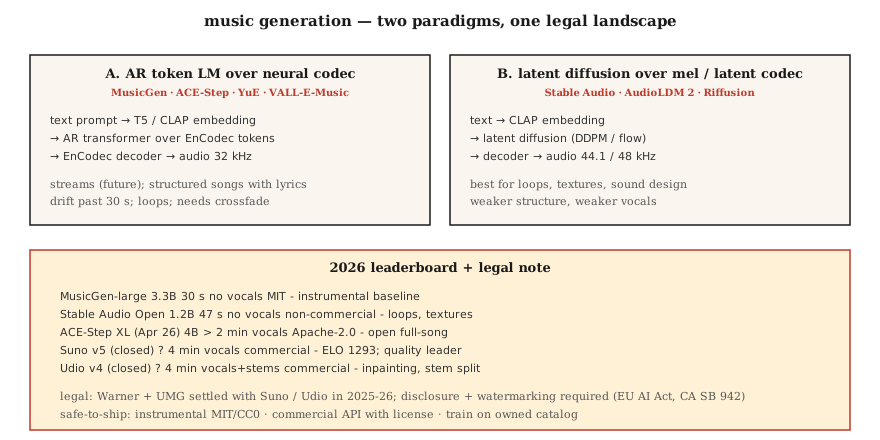
Token LM over neural-codec tokens
Meta's MusicGen (2023, MIT) and many derivatives: condition on text/melody embeddings, autoregressively predict EnCodec tokens (32 kHz, 4 codebooks), decode with EnCodec. 300M - 3.3B params. Strong baseline; struggles past 30 seconds.
ACE-Step (open-source, 4B XL released April 2026) extends this for full-song lyric-conditioned generation. The open community's closest thing to Suno.
Diffusion over mels or latents
Stable Audio (2023) and Stable Audio Open (2024): latent diffusion on compressed audio. Excels at loops, sound design, ambient textures. Not great at structured full songs.
AudioLDM / AudioLDM2: text-to-audio via T2I-style latent diffusion, generalized to music, sound effects, speech.
Hybrid (production), Suno, Udio, Lyria
Closed weights. Likely AR codec LM + diffusion-based vocoder with specialized voice / drum / melody heads. Suno v5 (2026) is the ELO 1293 quality leader. Udio v4 adds inpainting + stem separation (bass, drums, vocals separate downloads).
Evaluation
- FAD (Fréchet Audio Distance). Embedding-level distance between generated vs real audio distribution using VGGish or PANNs features. Lower is better. MusicGen small: 4.5 FAD on MusicCaps; SOTA ~3.0.
- Musicality (subjective). Human preference. Suno v5 ELO 1293 leads.
- Text-audio alignment. CLAP score between prompt and output.
- Musicality artifacts. Off-beat transitions, vocal-phrase drift, loss of structure past 30 s.
2026 model map
| Model | Params | Length | Vocals | License |
|---|---|---|---|---|
| MusicGen-large | 3.3B | 30 s | no | MIT |
| Stable Audio Open | 1.2B | 47 s | no | Stability non-commercial |
| ACE-Step XL (Apr 2026) | 4B | > 2 min | yes | Apache-2.0 |
| YuE | 7B | > 2 min | yes, multilingual | Apache-2.0 |
| Suno v5 (closed) | ? | 4 min | yes, ELO 1293 | commercial |
| Udio v4 (closed) | ? | 4 min | yes + stems | commercial |
| Google Lyria 3 (closed) | ? | real-time | yes | commercial |
| MiniMax Music 2.5 | ? | 4 min | yes | commercial API |
The legal landscape (2025-2026)
- Warner Music vs Suno settlement. $500M. WMG now has oversight of AI-likeness, music rights, and user-generated tracks on Suno. Similar UMG settlement on Udio.
- EU AI Act + California SB 942: AI-generated music must be disclosed.
- Riffusion / MusicGen under MIT have no compliance baggage but also no commercial vocals.
Safe-to-ship patterns:
- Generate instrumental only (MusicGen, Stable Audio Open, MIT/CC0 outputs).
- Use commercial APIs (Suno, Udio, ElevenLabs Music) with per-generation license.
- Train on owned or licensed catalog (most enterprises end up here).
- Tag generations with watermarks + metadata.
Build It
Step 1: generate with MusicGen
from audiocraft.models import MusicGen
import torchaudio

model = MusicGen.get_pretrained("facebook/musicgen-small")
model.set_generation_params(duration=10)
wav = model.generate(["upbeat synthwave with driving drums, 128 BPM"])
torchaudio.save("out.wav", wav[0].cpu(), 32000)
Three sizes: small (300M, fast), medium (1.5B), large (3.3B). Small is enough for "does the idea land."
Step 2: melody conditioning
melody, sr = torchaudio.load("humming.wav")
wav = model.generate_with_chroma(
    ["jazz piano cover"],
    melody.squeeze(),
    sr,
)
MusicGen-melody takes a chromagram and preserves the tune while swapping timbre. Useful for "give me this melody as a string quartet."
Step 3: FAD evaluation
from frechet_audio_distance import FrechetAudioDistance
fad = FrechetAudioDistance()

fad.get_fad_score("generated_folder/", "reference_folder/")
Computes VGGish-embedding distance. Useful for genre-level regression tests; not a substitute for human listeners.
Step 4: adding to the LLM-music workflow
Combine with the ideas from Lessons 7-8:
prompt = "Write a 30-second jazz loop. Describe the drums, bass, and piano voicing."
description = llm.complete(prompt)
music = musicgen.generate([description], duration=30)
Use It
| Goal | Stack |
|---|---|
| Instrumental sound design | Stable Audio Open |
| Game / adaptive music | Google Lyria RealTime (closed) |
| Full songs with vocals (commercial) | Suno v5 or Udio v4 with explicit license |
| Full songs with vocals (open) | ACE-Step XL or YuE |
| Short ad jingle | MusicGen melody-conditioned on a hummed reference |
| Music-video background | MusicGen + Stable Video Diffusion |
Pitfalls that still ship in 2026
- Copyright-laundering prompts. "Song in the style of Taylor Swift", commercial Suno/Udio filter these now, open models do not. Add your own filter list.
- Repetition / drift past 30 s. AR models loop. Crossfade multiple generations, or use ACE-Step for structural coherence.
- Tempo drift. Models wander off the BPM. Use BPM tags in the prompt and post-filter with librosa's
beat_track. - Vocal intelligibility. Suno is excellent; open models are often mushy on words. If lyrics matter, use a commercial API or fine-tune.
- Mono output. Open models generate mono or fake-stereo. Upgrade with a proper stereo reconstruction (ezst, Cartesia's stereo diffusion).
Ship It
Save as outputs/skill-music-designer.md. Pick model, license strategy, length / structure plan, and disclosure metadata for a music-gen deployment.
Exercises
- Easy. Run
code/main.py. It produces a "generative" chord progression + drum pattern as ASCII symbols, a music-gen cartoon. Play it back via any MIDI renderer if you want. - Medium. Install
audiocraftgenerate 10-second clips across 4 genre prompts with MusicGen-small, measure FAD against a reference genre set. - Hard. Using ACE-Step (or MusicGen-melody), generate three variations of the same tune with different timbre prompts. Compute CLAP similarity to the prompt to verify alignment.
Key Terms
| Term | What people say | What it actually means |
|---|---|---|
| FAD | Audio FID | Fréchet distance between embedding distributions of real vs generated. |
| Chromagram | Melody as pitches | 12-dim per-frame vector; input to melody conditioning. |
| Stems | Instrument tracks | Separated bass / drums / vocals / melody as WAV. |
| Inpainting | Regen a section | Mask a time window; model regenerates just that. |
| CLAP | Text-audio CLIP | Contrastive audio-text embedding; eval text-audio alignment. |
| EnCodec | Music codec | Meta's neural codec used by MusicGen; 32 kHz, 4 codebooks. |
Further Reading
- Copet et al. (2023). MusicGenthe open autoregressive benchmark.
- Evans et al. (2024). Stable Audio Openthe sound-design default.
- ACE-Stepopen 4B full-song generator, April 2026.
- Suno v5 platform docsthe commercial quality leader.
- AudioLDM2latent diffusion for music + sound effects.
- WMG-Suno settlement coverageNov 2025 precedent.
The full code
Every file for this lesson. Copy it, run it, then change it.
"""Music-generation cartoon: symbolic chord/drum generation from a prompt.

This is a pedagogical stand-in. Real music-gen uses neural codec LM
(MusicGen / ACE-Step) or latent diffusion (Stable Audio). Here we walk
through the "tokens over time" idea at a symbolic level so the shape is
visible.

Stdlib only. Run: python3 code/main.py
"""

import random


MAJOR_KEYS = {
    "C": ["C", "Dm", "Em", "F", "G", "Am", "Bdim"],
    "G": ["G", "Am", "Bm", "C", "D", "Em", "F#dim"],
    "D": ["D", "Em", "F#m", "G", "A", "Bm", "C#dim"],
    "A": ["A", "Bm", "C#m", "D", "E", "F#m", "G#dim"],
}

COMMON_PROGRESSIONS = {
    "pop":     [1, 5, 6, 4],
    "ballad":  [1, 6, 4, 5],
    "jazz":    [2, 5, 1, 6],
    "rock":    [1, 4, 5, 1],
    "lofi":    [6, 4, 1, 5],
}

DRUM_PATTERNS = {
    "pop":    "X.o.X.o.X.o.X.o.",
    "rock":   "X..oX..oX..oX..o",
    "lofi":   "X...o...X...o.o.",
    "jazz":   "X.oox.oxX.oox.ox",
    "trap":   "Xooox.oxXooox.ox",
}


def chord_progression(key, genre, bars=8):
    scale = MAJOR_KEYS[key]
    pat = COMMON_PROGRESSIONS.get(genre, COMMON_PROGRESSIONS["pop"])
    repeats = bars // len(pat) + 1
    seq = (pat * repeats)[:bars]
    return [scale[i - 1] for i in seq]


def drum_pattern(genre, bars=8):
    base = DRUM_PATTERNS.get(genre, DRUM_PATTERNS["pop"])
    return (base * bars)[: bars * 16]


def fake_generate(prompt, rng=None):
    rng = rng or random.Random(0)
    prompt_lower = prompt.lower()
    key = "C"
    for k in MAJOR_KEYS:
        if f" {k.lower()}" in " " + prompt_lower:
            key = k
            break
    genre = "pop"
    for g in COMMON_PROGRESSIONS:
        if g in prompt_lower:
            genre = g
            break
    bars = 8
    bpm = 120
    for token in prompt_lower.split():
        if token.endswith("bpm"):
            try:
                bpm = int(token[:-3])
            except ValueError:
                pass
    return {
        "key": key,
        "genre": genre,
        "bpm": bpm,
        "bars": bars,
        "chords": chord_progression(key, genre, bars),
        "drums": drum_pattern(genre, bars),
    }


def visualize(piece):
    print(f"  key: {piece['key']}  genre: {piece['genre']}  tempo: {piece['bpm']} bpm  bars: {piece['bars']}")
    print(f"  chords: {' | '.join(piece['chords'])}")
    drum = piece["drums"]
    print(f"  drums (kick=X snare=o): {drum}")


def main():
    prompts = [
        "upbeat pop in G major at 128 bpm",
        "slow lofi groove in C",
        "rock anthem in D at 140 bpm",
        "jazz swing in A",
    ]

    print("=== Step 1: prompt → symbolic music piece (toy) ===")
    for p in prompts:
        print(f"prompt: {p!r}")
        piece = fake_generate(p)
        visualize(piece)
        print()

    print("=== Step 2: 2026 music-gen model cheatsheet ===")
    models = [
        ("MusicGen-large",     3300, "30 s",  "no",  "MIT"),
        ("Stable Audio Open",  1200, "47 s",  "no",  "non-commercial"),
        ("ACE-Step XL (Apr 26)", 4000, "2 min+", "yes", "Apache-2.0"),
        ("YuE",                7000, "2 min+", "yes", "Apache-2.0"),
        ("Suno v5 (closed)",      0, "4 min",  "yes", "commercial"),
        ("Udio v4 (closed)",      0, "4 min",  "yes + stems", "commercial"),
    ]
    print("  | model               | params (M) | length | vocals | license        |")
    for name, p, length, v, lic in models:
        print(f"  | {name:<20} | {p:>10} | {length:>6} | {v:<12} | {lic:<14} |")

    print()
    print("takeaways:")
    print("  - open models: MusicGen (instrumental), ACE-Step / YuE (full song)")
    print("  - commercial: Suno v5 = quality leader; Udio v4 = producer tools (stems + inpaint)")
    print("  - legal: Warner + UMG settlements (2025-2026) define safe zones")
    print("  - always tag AI-generated music with watermark + metadata disclosure")


if __name__ == "__main__":
    main()
Most people stop here. Don't be most people.
The next 8 lessons are where Phase 06 turns from understanding into ability: the harder builds, the production patterns and the quizzes that prove you've actually got it. Unlock the full AI Expert Masterclass: all 542 expert lessons, every line of code, every phase.
- 10Audio-Language Models, Qwen2.5-Omni, Audio Flamingo, GPT-4o Audio
- 11Real-Time Audio Processing
- 12Build a Voice Assistant Pipeline, The Phase 6 Capstone
- 13Neural Audio Codecs, EnCodec, SNAC, Mimi, DAC and the Semantic-Acoustic Split
- + 4 more in this phase, and 542 across the whole masterclass