Speech Recognition (ASR), CTC, RNN-T, Attention
Speech recognition is audio classification at every timestep, glued together by a sequence model that knows English and silence. CTC, RNN-T, and attention are the three ways to do it. Pick one and understand why.
The Problem
You have a 10-second 16 kHz clip. You want a string: "turn on the kitchen lights". The challenge is structural: audio frames do not align one-to-one with characters. The word "okay" might take 200 ms or 1200 ms. Silence punctuates the utterance. Some phonemes are longer than others. The number of output tokens is not known in advance.
Three formulations solve this:
- CTC (Connectionist Temporal Classification). Emit per-frame token probabilities including a special blank. Collapse repeats and blanks at decode time. Non-autoregressive, fast. Used by wav2vec 2.0, MMS.
- RNN-T (Recurrent Neural Network Transducer). Joint network predicts next token given encoder frame and previous tokens. Streamable. Used by Google's on-device ASR, NVIDIA Parakeet.
- Attention encoder-decoder. Encoder compresses audio to hidden states, decoder cross-attends to generate tokens autoregressively. Used by Whisper, SeamlessM4T.
In 2026, SOTA WER on LibriSpeech test-clean is 1.4% (Parakeet-TDT-1.1B, NVIDIA) and 1.58% (Whisper-Large-v3-turbo). The differences are tiny; the deployment differences are huge.
The Concept
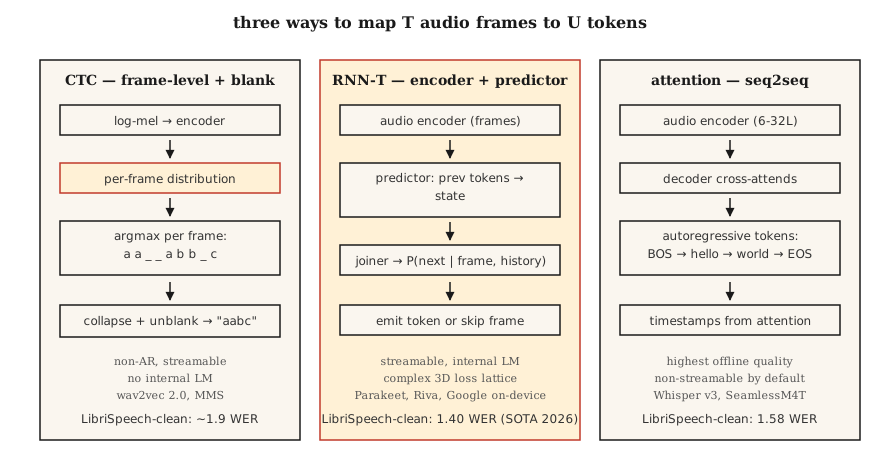
CTC intuition. Let the encoder output T frame-level distributions over V+1 tokens (V chars + blank). For a target string y of length U < Tany frame alignment that collapses to y counts. CTC loss sums over all such alignments. Inference: per-frame argmax, collapse repeats, remove blanks.
Advantages: non-autoregressive, streamable, zero lookahead. Drawback: conditional independence assumptioneach frame prediction is independent of the others, so there is no internal language model. Fix with an external LM via beam search or shallow fusion.
RNN-T intuition. Adds a predictor network that embeds the token history and a joiner that combines predictor state with encoder frame into a joint distribution over V+1 (the +1 is a null / no-emit). Explicitly models the conditional dependence CTC ignored. Streamable because each step conditions only on past frames and past tokens.
Advantages: streamable + internal LM. Drawback: training is more complex and memory-hungry (3D loss lattice); RNN-T loss kernels are a whole library category on their own.
Attention encoder-decoder. Encoder (6-32 transformer layers) over log-mel frames. Decoder (6-32 transformer layers) cross-attends to encoder outputs to generate tokens autoregressively. No alignment constraint, attention can look anywhere in the audio. Non-streamable unless you restrict attention (chunked Whisper-Streaming, 2024).
Advantages: highest quality on offline ASR, easy to train with standard seq2seq tooling. Drawback: autoregressive latency is proportional to output length; cannot stream without engineering.
WER: the one number
Word Error Rate = $(S + D + I) / N$, where $S$=substitutions, $D$=deletions, $I$=insertions, $N$=reference word count. Matches Levenshtein edit distance at the word level. Lower is better. A WER above 20% is generally unusable; below 5% is human-parity for read speech. 2026 numbers on standard benchmarks:
| Model | LibriSpeech test-clean | LibriSpeech test-other | Size |
|---|---|---|---|
| Parakeet-TDT-1.1B | 1.40% | 2.78% | 1.1B params |
| Whisper-Large-v3-turbo | 1.58% | 3.03% | 809M |
| Canary-1B Flash | 1.48% | 2.87% | 1B |
| Seamless M4T v2 | 1.7% | 3.5% | 2.3B |
All these are encoder-decoder or RNN-T based. Pure CTC systems (wav2vec 2.0) sit around 1.8 to 2.1% on test-clean.
Build It
Step 1: greedy CTC decode
def ctc_greedy(frame_logits, blank=0, vocab=None):
    # frame_logits: list of per-frame probability vectors
    preds = [max(range(len(p)), key=lambda i: p[i]) for p in frame_logits]
    out = []
    prev = -1
    for p in preds:
        if p != prev and p != blank:
            out.append(p)
        prev = p
    return "".join(vocab[i] for i in out) if vocab else out
Two rules: collapse consecutive repeats, drop blanks. Example: a a _ _ a b b _ c → a a b c.
Step 2: beam-search CTC
def ctc_beam(frame_logits, beam=8, blank=0):
    import math
    beams = [([], 0.0)]  # (tokens, log_prob)
    for p in frame_logits:
        log_p = [math.log(max(pi, 1e-10)) for pi in p]
        candidates = []
        for seq, lp in beams:
            for t, lpt in enumerate(log_p):
                new = seq[:] if t == blank else (seq + [t] if not seq or seq[-1] != t else seq)
                candidates.append((new, lp + lpt))
        candidates.sort(key=lambda x: -x[1])
        beams = candidates[:beam]
    return beams[0][0]
Production uses prefix tree beam search with LM fusion; this is the conceptual skeleton.
Step 3: WER
def wer(ref, hyp):
    r, h = ref.split(), hyp.split()
    dp = [[0] * (len(h) + 1) for _ in range(len(r) + 1)]
    for i in range(len(r) + 1):
        dp[i][0] = i
    for j in range(len(h) + 1):
        dp[0][j] = j
    for i in range(1, len(r) + 1):
        for j in range(1, len(h) + 1):
            cost = 0 if r[i - 1] == h[j - 1] else 1
            dp[i][j] = min(
                dp[i - 1][j] + 1,
                dp[i][j - 1] + 1,
                dp[i - 1][j - 1] + cost,
            )
    return dp[len(r)][len(h)] / max(1, len(r))
Step 4: inference against Whisper
import whisper
model = whisper.load_model("large-v3-turbo")
result = model.transcribe("clip.wav")
print(result["text"])
One-liner for the strongest general ASR in 2026. Runs on a 24 GB GPU at ~20× realtime.
Step 5: streaming with Parakeet or wav2vec 2.0
from transformers import pipeline
asr = pipeline("automatic-speech-recognition", model="nvidia/parakeet-tdt-1.1b")
for chunk in streaming_audio():
    print(asr(chunk, return_timestamps=True))
Streaming ASR needs chunked encoder attention and carryover state; use a library that supports it (NeMo for Parakeet, transformers pipeline with chunk_length_s).
Use It
The 2026 stack:
| Situation | Pick |
|---|---|
| English, offline, max quality | Whisper-large-v3-turbo |
| Multilingual, robust | SeamlessM4T v2 |
| Streaming, low latency | Parakeet-TDT-1.1B or Riva |
| Edge, mobile, <500 ms latency | Whisper-Tiny quantized or Moonshine (2024) |
| Long-form | Whisper with VAD-based chunking (WhisperX) |
| Domain-specific (medical, legal) | Fine-tune wav2vec 2.0 + domain LM fusion |
Pitfalls that still ship in 2026
- No VAD. Running Whisper on silence produces hallucinations ("Thanks for watching!"). Always gate with VAD.
- Character vs word vs subword WER. Report word-level WER after normalization (lowercase, punctuation stripped).
- Language ID drift. Whisper's auto LID mis-routes noisy clips to Japanese or Welsh; force
language="en"when you know. - Long clips without chunking. Whisper has a 30-second window. Use
chunk_length_s=30, stride=5for anything longer.
Ship It
Save as outputs/skill-asr-picker.md. Pick model, decoding strategy, chunking, and LM fusion for a given deployment target.
Exercises
- Easy. Run
code/main.py. It greedily decodes a hand-crafted CTC output and computes WER against a reference. - Medium. Implement the prefix-tree beam search in Step 2 properly (account for the blank merge rule). Compare with greedy on a 10-example synthetic dataset.
- Hard. Use
whisper-large-v3-turboon LibriSpeech test-clean. Compute WER on the first 100 utterances. Compare with published numbers.
Key Terms
| Term | What people say | What it actually means |
|---|---|---|
| CTC | The blank-token loss | Marginal over all frame-to-token alignments; non-AR. |
| RNN-T | The streaming loss | CTC + next-token predictor; handles word-order. |
| Attention enc-dec | Whisper-style | Encoder + cross-attending decoder; best offline quality. |
| WER | The number you report | (S+D+I)/N at word level. |
| Blank | The emptiness | Special token in CTC signalling "no emission this frame". |
| LM fusion | External language model | Add weighted LM log-probs during beam search. |
| VAD | The silence gate | Voice activity detector; trims non-speech. |
Further Reading
- Graves et al. (2006). Connectionist Temporal Classificationthe CTC paper.
- Graves (2012). Sequence Transduction with RNNsthe RNN-T paper.
- Radford et al. / OpenAI (2022). Whisper: Robust Speech Recognition via Large-Scale Weak Supervisionthe 2022 canonical paper; v3-turbo extension in 2024.
- NVIDIA NeMo, Parakeet-TDT card2026 Open ASR Leaderboard leader.
- Hugging Face, Open ASR Leaderboardlive benchmark across 25+ models.
The full code
Every file for this lesson. Copy it, run it, then change it.
"""ASR basics: greedy CTC decode, beam CTC decode, Word Error Rate.

Stdlib only. Builds a tiny hand-rolled CTC example and computes WER.
Run: python3 code/main.py
"""

import math
import random
from collections import Counter


BLANK = 0
VOCAB = "_abcdefghijklmnopqrstuvwxyz "  # index 0 is blank


def ctc_greedy(frame_probs):
    preds = [max(range(len(p)), key=lambda i: p[i]) for p in frame_probs]
    out = []
    prev = -1
    for p in preds:
        if p != prev and p != BLANK:
            out.append(p)
        prev = p
    return "".join(VOCAB[i] for i in out)


def ctc_beam(frame_probs, beam_width=8):
    beams = [((), 0.0)]
    for p in frame_probs:
        log_p = [math.log(max(pi, 1e-10)) for pi in p]
        new_beams = {}
        for seq, lp in beams:
            for t, lpt in enumerate(log_p):
                if t == BLANK:
                    new_seq = seq
                else:
                    if seq and seq[-1] == t:
                        new_seq = seq
                    else:
                        new_seq = seq + (t,)
                if new_seq in new_beams:
                    new_beams[new_seq] = math.log(math.exp(new_beams[new_seq]) + math.exp(lp + lpt))
                else:
                    new_beams[new_seq] = lp + lpt
        beams = sorted(new_beams.items(), key=lambda x: -x[1])[:beam_width]
    best = beams[0][0]
    return "".join(VOCAB[i] for i in best)


def wer(ref, hyp):
    r = ref.split()
    h = hyp.split()
    nr = len(r)
    if nr == 0:
        return 0.0 if not h else 1.0
    dp = [[0] * (len(h) + 1) for _ in range(nr + 1)]
    for i in range(nr + 1):
        dp[i][0] = i
    for j in range(len(h) + 1):
        dp[0][j] = j
    for i in range(1, nr + 1):
        for j in range(1, len(h) + 1):
            cost = 0 if r[i - 1] == h[j - 1] else 1
            dp[i][j] = min(dp[i - 1][j] + 1, dp[i][j - 1] + 1, dp[i - 1][j - 1] + cost)
    return dp[nr][len(h)] / nr


def one_hot_like(char, noise=0.02, vocab_size=len(VOCAB)):
    base = [noise] * vocab_size
    idx = VOCAB.index(char)
    base[idx] = 1.0 - noise * (vocab_size - 1)
    return base


def build_frame_probs(target, duration_per_char=3, blank_runs=1):
    random.seed(0)
    frames = []
    for c in target:
        for _ in range(duration_per_char):
            frames.append(one_hot_like(c))
        for _ in range(blank_runs):
            frames.append(one_hot_like("_"))
    return frames


def corrupt(probs, n_swaps=3, swap_strength=0.4):
    random.seed(1)
    out = [list(p) for p in probs]
    for _ in range(n_swaps):
        i = random.randrange(len(out))
        j1 = random.randrange(len(out[i]))
        j2 = random.randrange(len(out[i]))
        swap = swap_strength
        out[i][j1] -= swap
        out[i][j2] += swap
    return out


def main():
    target = "hello world"
    print("=== Step 1: build per-frame CTC outputs for target ===")
    print(f"  target: {target!r}")
    probs = build_frame_probs(target, duration_per_char=3, blank_runs=1)
    print(f"  frames: {len(probs)}  vocab: {len(VOCAB)}  (index 0 = blank)")

    print()
    print("=== Step 2: greedy decode (collapse repeats, drop blank) ===")
    greedy = ctc_greedy(probs)
    print(f"  greedy decode: {greedy!r}")

    print()
    print("=== Step 3: beam search decode (width 8, simplified) ===")
    beam = ctc_beam(probs, beam_width=8)
    print(f"  beam decode:   {beam!r}")
    print(f"  note: this beam merges consecutive repeats without a blank-intervene state;")
    print(f"  a proper prefix-tree beam (e.g. ctcdecode) tracks P_blank / P_nonblank and")
    print(f"  preserves double letters like the two l's in 'hello'.")

    print()
    print("=== Step 4: corrupt logits; beam should beat greedy ===")
    corrupted = corrupt(probs, n_swaps=6, swap_strength=0.6)
    g2 = ctc_greedy(corrupted)
    b2 = ctc_beam(corrupted, beam_width=16)
    print(f"  greedy: {g2!r}")
    print(f"  beam:   {b2!r}")

    print()
    print("=== Step 5: WER ===")
    ref = "hello world this is a test"
    hyps = {
        "perfect":      "hello world this is a test",
        "one substit":  "hello world this is the test",
        "one deletion": "hello world this a test",
        "one insert":   "hello world this is a big test",
        "garbage":      "bye everyone nothing here",
    }
    for label, hyp in hyps.items():
        print(f"  {label:<14} WER = {wer(ref, hyp):.3f}  hyp={hyp!r}")

    print()
    print("=== Step 6: best model on LibriSpeech test-clean (2026) ===")
    table = [
        ("Parakeet-TDT-1.1B", 1.40, "1.1B"),
        ("Canary-1B Flash",   1.48, "1B"),
        ("Whisper-L-v3-turbo", 1.58, "809M"),
        ("Seamless M4T v2",    1.70, "2.3B"),
        ("wav2vec 2.0 Large",  1.92, "317M"),
    ]
    print("  | Model                 | WER  | Params |")
    for name, w, p in table:
        print(f"  | {name:<21} | {w:.2f} | {p:<6} |")


if __name__ == "__main__":
    main()