Make it legal: tax, invoices and GDPR for your first clients (UK)
Make £20,000 profit in your first year and your first January tax bill is not £1,931.80. It's £2,897.70, because HMRC wants half of next year's up front. This is the afternoon that stops surprises like that: the right setup, HMRC dates, records, invoices, late payers and UK GDPR, with every rule linked to its official source.
- Invoices that get paid: a legal checklist, payment terms and your rights when clients pay late
- Client data done properly: the ICO fee check, a privacy notice, simple terms and a 30-day setup plan
- A service you plan to sell (or already sell). No idea yet? Start with Find 20 businesses worth pitching
- A spreadsheet app (Excel, Google Sheets or LibreOffice), a calendar and about 85 minutes
- Nothing to install. The kit is free: download it here
Choose your setup: sole trader or limited company
Most people start as a sole trader. Know what that means, what a company changes, and why people switch.
Steps 1 to 6 are what to sort before your first invoice: setup, HMRC, tax, money-savers, records and invoicing. Steps 7 and 8 are for once you have clients: their data, your terms and insurance. This mission is general information, not tax or legal advice: for your own situation, check the linked pages or ask an accountant.
Getting paid is the fun part. Staying on the right side of HMRC and the ICO is the bit that makes it last, and it's less work than people think. First decision: how you'll trade. gov.uk's comparison page ↗ sets out the two common options. In plain English:
- Sole trader: you and the business are the same thing in law. You can start trading straight away without registering anything first. Your profit is taxed as your income through Self Assessment. You're personally responsible for any business debts.
- Limited company: the company is a separate legal "person". It must be registered with Companies House before it trades. The company pays Corporation Tax on its profit, and you take money out as salary, dividends or a director's loan. Your liability for its debts is limited to what you put in.
What a company adds:
- Registering costs £100 online (gov.uk ↗), and directors need to verify their identity with GOV.UK One Login.
- Corporation Tax is 19% on profits up to £50,000 and 25% over £250,000, with marginal relief in between (gov.uk ↗).
- Dividends above a £500 allowance are taxed at 10.75% (basic rate), 35.75% (higher) or 39.35% (additional) for 2026 to 2027 (gov.uk ↗).
- Every year: annual accounts, a Company Tax Return, and a confirmation statement that costs £50 online (gov.uk ↗).
- The company's money isn't your money. You take it out in the ways gov.uk lists ↗, each with its own tax rules.
When do people switch?gov.uk gives no single figure. The usual reasons:
- Profit: with steady, higher profits a company can work out cheaper in tax. Whether it does depends on your own figures, and the saving has to beat the extra admin and accountant's fees. An accountant can compare both for your real numbers.
- Clients: some bigger clients prefer to work with companies. If you then work for one client much like an employee, the off-payroll working rules (IR35) ↗ may apply.
- Risk: if a mistake could lead to a big claim, limited liability keeps the company's debts separate from your own assets. Insurance (step 8) is the other way to handle that risk.
TipStarting as a sole trader is the simplest way to test a service, and it costs nothing to set up. You can form a company later. Going into business with a friend and splitting the profit is usually a partnership ↗, which has its own rules. The rest of this mission assumes you're a sole trader in England, and flags where companies differ.CarefulWhere people slip up. It's rarely the tax rate. It's thinking the £1,000 limit means profit (it means income before expenses), missing the 5 October registration deadline, a first January bill that's bigger than expected, and no receipts when the return is due. None of it is hard: an hour now and ten minutes a week. If you employ people, sell goods abroad, are already VAT registered, or work in a regulated field such as financial advice, get an accountant from the start.
If it breaksI have a full-time job. Can I still do this? + 2 more
I have a full-time job. Can I still do this?
Do I need a separate business bank account?
Do I have to register my business name?
Know when to tell HMRC: the £1,000 rule and your deadlines
People get caught out by dates far more than by tax. Work out yours now and put them in your calendar.
The trading allowancegov.uk describes it as a tax exemption of up to £1,000 a year ↗ for trading income. The tax year runs from 6 April to 5 April. Two rules matter:
- £1,000 or less of gross trading income in a tax year: you usually don't need to tell HMRC. You must still keep records of it.
- Over £1,000: you must register for Self Assessment. You then choose to deduct either the £1,000 allowance or your real expenses, not both.
CarefulGross means before expenses. Invoice £1,200 and spend £500 on software, and your profit is £700, but your gross income is £1,200. That's over £1,000, so you must register. In that example the allowance is the better choice: £200 taxable instead of £700.You can't use the allowance on income from your own employer (or your spouse's or civil partner's employer), from a company you or someone connected to you owns or controls, or from a partnership. It's £1,000 in total across all your trades, not £1,000 per client.
RegisteringRegister as self-employed on gov.uk ↗. The deadline is 5 October after the end of the tax year you first need to send a return for. HMRC then posts your Unique Taxpayer Reference (UTR), usually around 15 days later (gov.uk ↗). You don't have to wait: you can register as soon as you start.
If you start trading now, your first tax year is 2026 to 2027. Following the rules on gov.uk's deadlines page ↗, your dates are:
Your tax calendar (first tax year 2026 to 2027)5 April 2027 Tax year 2026 to 2027 ends 6 April 2027 You can send your return from this date 5 October 2027 Deadline to register for Self Assessment 31 October 2027 Deadline for a paper return 31 January 2028 Deadline to file online AND to pay 31 July 2028 Second payment on account, if it applies (step 3)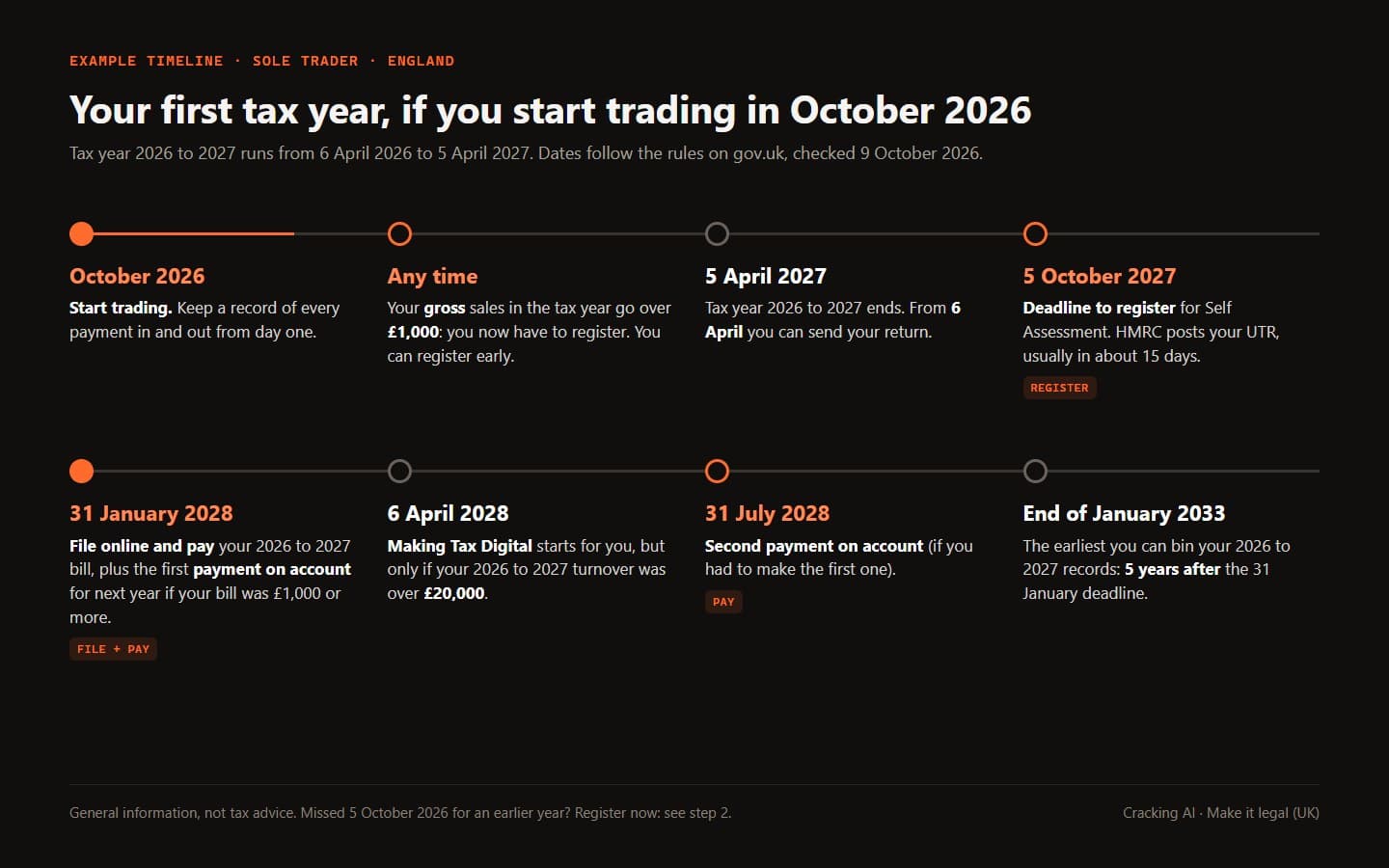
Your first tax year at a glance, if you start trading in October 2026. Miss a filing deadline and gov.uk says there's a £100 penalty straight away (penalties ↗). Already earned over £1,000 before 6 April 2026 and never registered?That was the 2025 to 2026 tax year, and its registration deadline was 5 October 2026. Register now. gov.uk says if you register after 5 October 2026, HMRC will give you 3 months from the date of its letter or email to send the return, but you must still pay by 31 January 2027.
Paid through a platform?Under the digital platform reporting rules ↗, platforms may have to collect your details and report what you earn to HMRC. The small-seller exception (fewer than 30 sales and about £1,700 a year) covers goods only, not services. Every payment counts, whether it arrives by bank transfer, card, platform payout or cash.
TipNot sure whether you need a return at all? HMRC has a quick checker ↗.
If it breaksI missed the 5 October deadline + 2 more
I missed the 5 October deadline
I made a loss in my first year. Do I still register?
I get Universal Credit or another benefit
Work out what you'll pay, and what you can claim
Know the 2026 to 2027 rates, the expenses that count, and how much to put aside from every payment.
Income TaxFor 2026 to 2027 the Personal Allowance is £12,570. Above it, England, Wales and Northern Ireland pay 20% up to £50,270, 40% up to £125,140 and 45% above that (gov.uk ↗). Scotland has its own bands ↗. Your profit is added to any wages, so if a job already uses up your Personal Allowance, your business profit is taxed from the first pound.
National InsuranceSince 6 April 2024 the self-employed no longer have to pay Class 2 ↗. For 2026 to 2027, gov.uk ↗ says:
- Class 2: if your profits are £7,105 or more, it's treated as paid, which protects your National Insurance record. Below £7,105 you can choose to pay voluntary Class 2 at £3.65 a week.
- Class 4: 6% on profits between £12,570 and £50,270, then 2% above £50,270. You pay it through Self Assessment along with your Income Tax.
A worked exampleExample numbers: a sole trader in England, no other income, 2026 to 2027 rates.
Example: £20,000 profitProfit for the year £20,000.00 Income Tax: (£20,000 - £12,570) x 20% £1,486.00 Class 4 NI: (£20,000 - £12,570) x 6% £445.80 Class 2 NI: profit over £7,105, treated as paid £0.00 Bill for 2026 to 2027 £1,931.80 Due 31 January 2028: the 2026 to 2027 bill £1,931.80 first payment on account for next year £965.90 total £2,897.70 Due 31 July 2028: second payment on account £965.90That January total is the shock: £2,897.70 due on one day, about 1.5 times the year's bill. Payments on account ↗ are advance payments towards next year's bill, each usually half of this year's. You make them unless your bill was under £1,000, or more than 80% of your tax was already paid another way (for example through a tax code). So in your first year, budget for about one and a half years' tax on the first 31 January.
TipMove a share of every payment into a separate savings pot the day it arrives. HMRC's tax bill estimator ↗, or the example above, will help you pick the percentage.ExpensesClaim real expenses instead of the £1,000 allowance and you pay tax only on profit. gov.uk's list of allowable expenses ↗ includes:
- Office costs: phone and internet bills, stationery, and software, including subscriptions you renew regularly (such as an AI tool you use for client work).
- Equipment such as a laptop: on the cash basis, the default for sole traders, it's an allowable expense.
- Business travel: fuel, parking, train and bus fares. Not travel between home and work.
- Financial costs such as business insurance and bank charges, advertising or marketing such as your own website, and training courses related to your business.
- Working from home: a fair share of heating, electricity, Council Tax, rent or mortgage interest and internet. Or the flat rate ↗: £10 a month for 25 to 50 hours, £18 for 51 to 100 hours, £26 for 101 hours or more. The flat rate doesn't include phone or internet.
- Business mileage in your own car or van: 55p a mile for the first 10,000 miles in 2026 to 2027, then 25p (simplified expenses ↗), instead of the actual running costs.
Not allowedeveryday clothes (even if you only wear them for work), client entertaining, fines, money you take for yourself, and your own Income Tax and National Insurance. For anything you also use personally, claim only the business share: gov.uk's example is a £200 phone bill with £70 of business calls, so you claim £70.
Allowance or expenses?Pick whichever is bigger. Example: you invoice £3,000 in the year. With £400 of expenses, the £1,000 allowance wins (£2,000 taxable instead of £2,600). With £1,500 of expenses, claim them (£1,500 taxable instead of £2,000).
If it breaksI don't know my profit yet, so how do I know what to save? + 2 more
I don't know my profit yet, so how do I know what to save?
I use my laptop and phone for personal things too
I live in Scotland
The money-savers most beginners miss
Five minutes here is often worth more than the whole tax rate debate.
- Pick the bigger of the allowance and your expenses. The £1,000 trading allowance beats real expenses when your costs are small, and real expenses win once they pass £1,000. Work it out both ways every year (step 3 has the example).
- Claim the tools you actually use. Your AI subscription, software, hosting and domain, a share of your phone and internet, and the laptop itself: on the cash basis a laptop you buy for the business is an allowable expense in the year you pay for it (gov.uk ↗). Claim only the business share of anything you also use personally.
- Working from home flat rate. No bills to split: £10 a month for 25 to 50 hours of business use at home, £18 for 51 to 100 hours, £26 for 101 hours or more (gov.uk ↗). That's up to £312 a year off your profit for doing nothing but keeping a note of your hours.
- Mileage at 55p. From 6 April 2026 the simplified rate for cars and vans is 55p a mile for the first 10,000 business miles (it was 45p), then 25p (gov.uk ↗). Log every client visit and trip to a supplier. 1,000 business miles is £550 off your profit.
- Charge the late-payment fixed sum. Business clients who pay late owe you £40, £70 or £100 per invoice on top of interest, depending on the size of the debt (step 6). Most freelancers never claim it.
- Protect your State Pension cheaply. Profits under £7,105 mean Class 2 isn't treated as paid. Voluntary Class 2 at £3.65 a week keeps your National Insurance record going (step 3).
- Pay the ICO fee by Direct Debit if you need to pay it: it's £5 cheaper (step 7).
Keep records HMRC would accept, and know when MTD and VAT matter
Ten minutes a week now saves a panic in January. Set up the spreadsheet and three folders.
gov.uk ↗ says to keep records of all sales and income and all business expenses, with proof such as receipts, bank statements and sales invoices. Your records must be accurate, and you must be able to pick out the business transactions.
Cash basis is the default for sole traders: you record income when the money arrives and expenses when you pay them, not when the invoice is dated (gov.uk ↗).
Download the record-keeping spreadsheet and open it in Excel, Google Sheets or LibreOffice. It has one row per payment in or out, with example rows to learn from (or start empty with the blank version):
records-template.csv (first columns)Date (money in or out),Type,Ref,Client or supplier,Description,Category,Amount (GBP),Business use (%),Business amount (GBP),... 2026-10-03,Expense,R-002,Example Computers Ltd,Laptop,Equipment (cash basis: allowable expense),900.00,80,720.00,... 2026-10-14,Expense,R-006,Example Cafe,Lunch with a prospective client,Not allowable (client entertaining),18.40,0,0.00,... 2026-10-21,Income,INV-001,Anytown Barbers Ltd,Local SEO audit and Google Business Profile clean-up,Sales,250.00,100,250.00,...Totals: paste into any empty cellIncome so far: =SUMIFS(I:I, B:B, "Income") Expenses so far: =SUMIFS(I:I, B:B, "Expense")Make three folders next to it:
invoices(every invoice as a PDF, numbered in order),receipts(a photo or PDF of every receipt, named by date, like2026-10-05-phone.pdf) andstatements(your bank statements).TipTen minutes every Friday: add the week's payments, file the receipts, mark which invoices are paid. On the short self-employment pages of the return, if your turnover was below £90,000 you can put your total expenses in one box ↗, so tidy weekly records make January quick.Making Tax Digital for Income Tax (MTD) means keeping digital records in compatible software and sending HMRC quarterly updates. gov.uk ↗ says it depends on your qualifying income ↗: self-employment and property income before expenses. Wages don't count.
- Over £50,000 in 2024 to 2025: MTD from 6 April 2026 (already started).
- Over £30,000 in 2025 to 2026: MTD from 6 April 2027.
- Over £20,000 in 2026 to 2027: MTD from 6 April 2028.
If you're starting now, the earliest it can apply to you is April 2028, and only if your 2026 to 2027 turnover goes over £20,000. HMRC checks each return and writes to people who need to join, but gov.uk says it's still your job to check. Quarterly updates are due by 7 August, 7 November, 7 February and 7 May, and HMRC won't apply penalty points ↗ for late quarterly updates in 2026 to 2027.
VATYou must register if your taxable turnover for the last 12 months goes over £90,000, or you expect it to go over £90,000 in the next 30 days alone, for example from one big contract (gov.uk ↗). It's a rolling 12 months, not the tax year. Most people starting out are nowhere near it. Until you're registered, don't add VAT to invoices. Some businesses register voluntarily below the threshold; talk to an accountant first, because you'd then have to charge VAT and send VAT returns.
invoices, receipts and statements folders.If it breaksI've lost a receipt + 2 more
I've lost a receipt
Do I need accounting software?
The spreadsheet shows dates as numbers or the £ sign looks odd
GBP and ISO dates (2026-10-03) so it opens cleanly everywhere. If your app shows a date as a number, select the column and set its format to Date.Send invoices that get paid, and know your rights when they're late
A proper invoice, agreed payment terms and a polite chasing routine solve most late payments before the law is needed.
What an invoice must include, according to gov.uk ↗:
- A unique invoice number. Number them in order: INV-001, INV-002 and so on.
- Your name, and your business name if you use one, plus your address and contact details. With a business name, add an address where legal documents can be delivered to you.
- The customer's name (or company name) and address.
- A clear description of what you're charging for.
- The date you provided the service (the supply date) and the date of the invoice.
- The amount(s) charged, VAT if applicable, and the total owed.
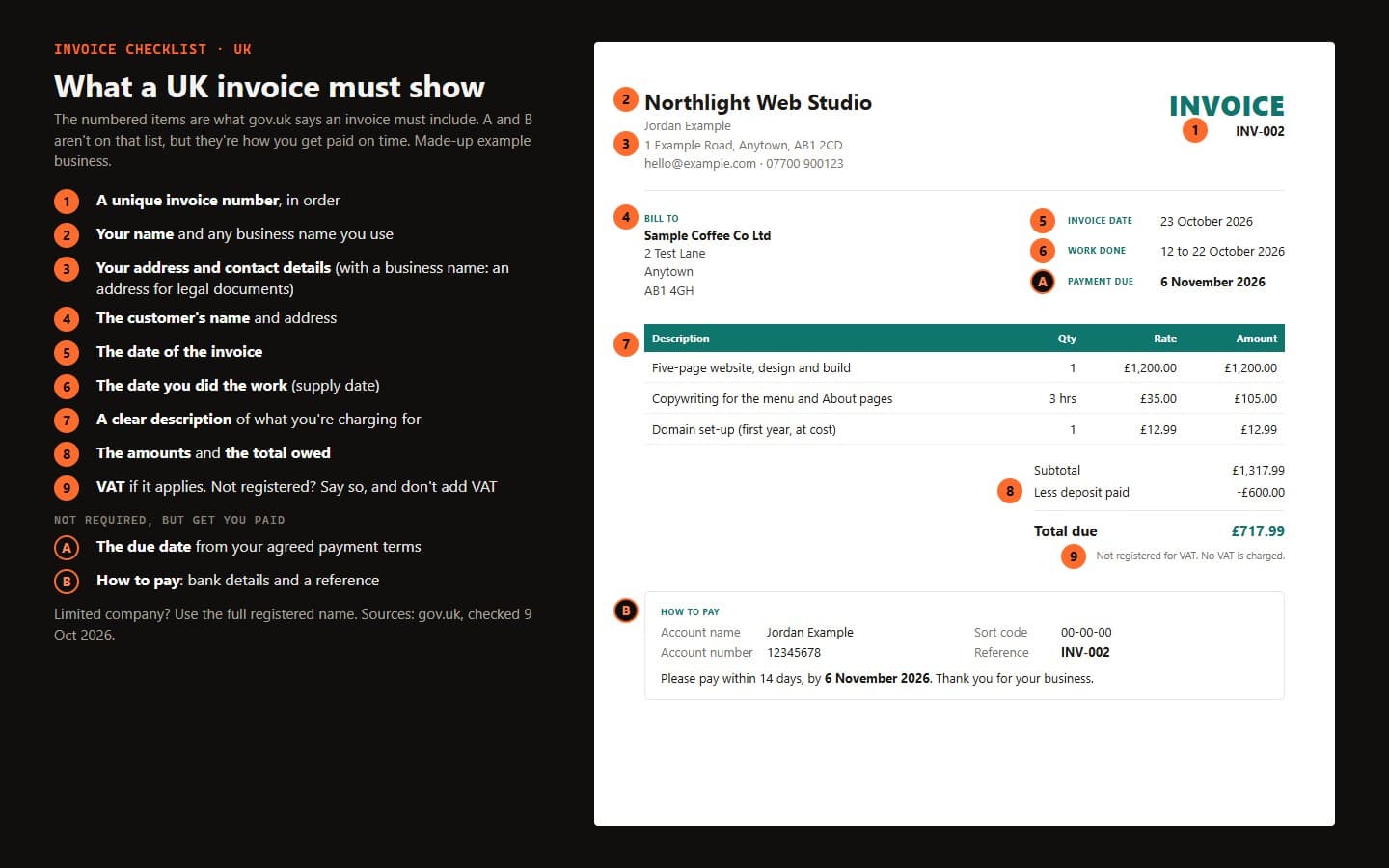
Every required item, marked on a sample invoice. A and B aren't legally required, but they're how you get paid on time. Not on the legal list, but they get you paid: the payment terms and actual due date ("Please pay within 14 days, by 6 November 2026"), your bank details with the invoice number as the reference, the client's purchase order number if they use them, and "Not registered for VAT" if that's you.
Limited company?The invoice must show the full company name exactly as on the certificate of incorporation, and if you list any directors' names you must list them all. The company number, registered office and where it's registered must go on your business letters, order forms and website (gov.uk ↗), and most companies put them on invoices too. VAT-registered businesses selling to other VAT-registered businesses must use VAT invoices, which need more detail.
TipThe lesson Beautiful invoices from plain text gives you a free Typst template that covers every item above, adds up the lines, takes off deposits and prints the due date for you.Payment termsYou can set your own, including a deposit or payment up front (gov.uk ↗). If you never agree a date, payment is late 30 days after the customer gets the invoice or you provide the service, whichever is later. Between businesses, an agreed date must usually be within 60 days (gov.uk ↗). Agree terms in writing before you start, and print them on every invoice.
When a business client pays late, the Late Payment of Commercial Debts (Interest) Act 1998 ↗ lets you claim the following, unless your contract sets a different interest rate:
- Statutory interest at 8% a year plus the Bank of England base rate. The base rate that counts is the one in force on 30 June or 31 December ↗: 30 June for debts that become late from 1 July to 31 December, 31 December for debts that become late from 1 January to 30 June. Bank Rate was 3.75% ↗ on 30 June 2026, so the rate for debts that become late in the second half of 2026 is 11.75% a year.
- A fixed sum for recovery costs, once per invoice: £40 for debts up to £999.99, £70 for £1,000 to £9,999.99 and £100 for £10,000 or more (gov.uk ↗).
Late payment maths (example)Invoice: £800, became late on 1 November 2026, paid 30 days late Rate: 8% + 3.75% = 11.75% a year Interest per year: £800 x 0.1175 = £94.00 Interest per day: £94.00 / 365 = about 25.8p 30 days late: 30 x £0.2575 = £7.73 Fixed sum: £40.00 (debt under £1,000) You can claim: £47.73gov.uk suggests sending a new invoice if you decide to add interest, and you can choose not to. It works best as the last step of a polite routine, not the first: a friendly reminder the day after the due date, a second one a week later asking if anything's holding it up, then a final notice. The law only covers business clients. For individual customers, take a deposit or payment up front.
Final reminder email (business clients)Subject: Final reminder: invoice INV-002 (£717.99) Hi [name], Invoice INV-002 for £717.99 was due on 6 November and is now 14 days overdue. I've attached it again. Please pay within 7 days, by [date]. If it's still unpaid after that, I'll add statutory interest and the fixed recovery sum allowed under the Late Payment of Commercial Debts (Interest) Act 1998, and send an updated invoice. I'd much rather not, so if there's a problem, please call me on [number] this week. Regards, [your name]If a business still won't pay, gov.uk's guide to making a court claim for money ↗ covers claiming online or by post, and mediation. A change is coming: a bill to tighten late-payment rules between businesses, the Commercial Payments Bill ↗, is going through Parliament. Until it becomes law, the rules above apply.
If it breaksThe client says they never got the invoice + 2 more
The client says they never got the invoice
They dispute part of the invoice
A big client wants 90-day payment terms
Handle client data properly (UK GDPR) and check the ICO fee
If you touch names, emails or customer lists, data protection law applies to you. The basics are short.
For any piece of personal data you're in one of two roles (ICO ↗):
- Controller: you decide why and how the data is used. You're the controller for your own client list, enquiries and invoices.
- Processor: you handle personal data on a client's behalf, only on their instructions. For example, cleaning up a client's customer spreadsheet or importing their mailing list into a new website.
The ICO data protection feeThe ICO says organisations, including sole traders, that use personal information must pay a fee unless they're exempt. You're exempt ↗ if you only use personal data for purposes such as:
- Staff administration.
- Advertising, marketing and public relations for your own business.
- Accounts and records.
- A few others, such as not-for-profit purposes and personal or household affairs.
The catch for service businesses: the ICO's sector guidance says consultants, marketing agencies and IT consultants that handle personal information while serving clients generally need to pay (professional services ↗, IT and media ↗). Acting purely as a processor on a client's instructions doesn't need a fee in itself. Using CCTV or a dashcam for your business usually does.
Don't guess: the ICO's fee self-assessment ↗ takes about 10 minutes. If you do need to pay, the fees ↗ are:
- Tier 1 (micro): £52 a year if your turnover is up to £632,000 or you have no more than 10 staff. That's nearly every freelancer.
- Tier 2: £78. Tier 3: £3,763.
- £5 off if you pay by Direct Debit, and it renews every 12 months. The fixed penalty ↗ for a tier 1 business that should have paid is £400, and it can go up to £4,350.
The basics, whether you pay or not:
- Tell people what you do with their data: a privacy notice on your website and enquiry forms. The ICO's free privacy notice generator ↗ is made for sole traders and small businesses.
- Give people a way to complain about how you used their data. Under the Data (Use and Access) Act, every organisation must now offer one ↗, acknowledge complaints within 30 days, investigate and tell the person the outcome. An email address in your privacy notice is a simple start.
- Keep it secure: a password manager, two-factor login on email and cloud accounts, encrypted files and backups you can restore.
- Keep only what you need, and delete or return a client's data when the job ends. Your invoices are different: tax law says to keep them for years (step 5).
- Processing for a client? Put it in writing. UK GDPR Article 28 ↗ says it must be under a written contract (electronic is fine). The ICO lists what it must cover ↗: acting only on the client's documented instructions, confidentiality, security, their permission before you use sub-processors, helping with people's data requests, deleting or returning data at the end, and showing you've complied. The kit has a clause outline.
- Breaches: if personal data is lost, leaked or locked by ransomware, a controller must report it to the ICO within 72 hours of becoming aware, unless it's unlikely to put anyone at risk, and record every breach either way (ICO guide ↗). As a processor, tell your client without undue delay (Article 33 ↗).
CarefulCareful with AI tools. Pasting a client's customer list or emails into an online AI chat hands that personal data to another company. As a processor you need your client's permission before you bring in a sub-processor, and an AI service can be one. Strip out names and contact details first, or use an AI on your own computer: Run AI on your PC or your own private ChatGPT.Marketing emails have their own rules (PECR). Price it, pitch it, get paid covers who you can email without asking first.
If it breaksThe self-assessment says I should pay, but I hardly handle any data + 2 more
The self-assessment says I should pay, but I hardly handle any data
A client wants me to sign their data processing agreement
Someone asks for a copy of the data I hold about them
Simple client terms, insurance and your first 30 days
A one-page agreement prevents most arguments, insurance covers the rest, and the 30-day plan gets it all done.
Agree a one-page set of terms by email before you start ("Reply 'agreed' to confirm"). It settles what clients and freelancers argue about: what's included, what it costs and when it's paid. The outline is also in the kit:
Client terms outline1. The work: the deliverables, and how many rounds of changes. 2. Not included: anything not listed, plus the obvious extras. 3. What I need from you: logins, text, photos and feedback by set dates. Delays on your side move the deadline. 4. Price and payment: fixed fee, 50% deposit before work starts, balance due within 14 days of invoice. Business clients: late payment interest under the Late Payment Act may apply. 5. Changes: extra work quoted in writing and agreed first. 6. Ownership: I own the copyright until you've paid in full, then [I assign it to you / you get a licence]. I can show the work in my portfolio unless you say no. 7. Your data: if I handle your customers' personal data, the data processing terms apply. 8. Confidentiality: both of us keep each other's business private. 9. Results and liability: reasonable care and skill; no guaranteed rankings, sales or enquiries; liability capped at the fee paid. 10. Ending it: either side, [7] days' written notice; you pay for work done to date. 11. Law: England and Wales [or Scotland / Northern Ireland].Who owns the work?Under copyright law ↗ the author is the first owner, and employees' work belongs to their employer. As a freelancer that means you, unless you agree otherwise. A transfer of copyright only works in writing, signed by you ↗, so say clearly whether the client gets the copyright (usually once they've paid in full) or a licence to use the work.
If your client is an individual, not a business, consumer law adds rules. Services must be carried out with reasonable care and skill ↗. If the contract is made online, by phone or email, or away from your premises, they usually have 14 days to cancel ↗. If they want you to start sooner, get their express request ↗ in writing. If they then cancel, they pay for what you've done so far, but only if you told them about the cancellation right. Never told them? gov.uk says they can cancel at any time in the next 12 months ↗.
TipSome liability can't be limited by law, so for bigger or riskier projects pay a solicitor to check your template once. You'll reuse it for years.InsuranceThe government's business.gov.uk ↗ sets out the main types:
- Professional indemnity (PI): covers claims that your advice, work or services caused a client a financial loss. It isn't a legal requirement for most freelancers. You need it if your industry or regulator requires it, and some clients make it a condition of the contract. Worth pricing up if a mistake in your work could cost a client money.
- Public liability: covers claims that a member of the public was injured or their property damaged. Not legally required, but worth considering if you visit clients or they visit you.
- Employers' liability: a legal requirement as soon as you employ someone, with at least £5 million of cover, and fines of £2,500 for every day you're not properly insured (gov.uk ↗). There are a few exceptions, such as only employing a family member.
Compare what each policy covers, not just the price: business.gov.uk warns that anything not mentioned isn't covered. Business insurance premiums are an allowable expense ↗.
Your first 30 daysWork through this plan. Most of it is a one-off, then it's ten minutes a week. The kit has the full version with tick boxes.
30-day setup planWEEK 1 Set up Choose sole trader or limited company. Note your start date Separate bank account or pot (check your bank allows business use) invoices / receipts / statements folders + the records spreadsheet Invoice template, starting at INV-001 Tax dates in your calendar, with reminders WEEK 2 Client paperwork One-page terms from the outline ICO fee self-assessment (10 minutes). Pay if it says so Privacy notice with the ICO generator, plus a complaints email Password manager, two-factor login, encrypted backups Insurance decision; quotes if you need PI or public liability WEEK 3 First invoice and money habits First invoice, with payment terms and a due date on it Tax pot: move your share in every time you're paid Register for Self Assessment once income this tax year passes £1,000 (or now, if you expect it to) WEEK 4 First monthly check Spreadsheet matches the bank? Anything overdue? Chase it Income vs £1,000, MTD (£20,000) and VAT (£90,000) Book 10 minutes every Friday for recordsWhen it's working: the next levelGet an accountant once things stop being simple: several income streams, big purchases, or a bill you can't estimate. Ask them whether a limited company would save you money once profits are steady. Keep an eye on the MTD and VAT thresholds as you grow. Tighten your terms: deposits on every project and monthly retainers paid in advance. And before you hire anyone, sort employers' liability insurance and PAYE first.
Get the full kit (tax calendar, invoice checklist, chasing emails, expenses list, processor clause, terms outline, 30-day plan and every source link), the records spreadsheet, or everything in one zip.
If it breaksThe client won't sign anything + 2 more
The client won't sign anything
The client sent me their own contract
Insurance looks expensive for one small job
Your first wins
It works. Now do something with it.
Turn the outline into your own one-page terms
Paste this into any AI chat, then read every line yourself before you send it to a client.
Write plain-English, one-page terms between me, a UK sole trader ([your service, e.g. websites for local businesses]), and a small business client. Use this structure: the work ([list deliverables], [2] rounds of changes); not included ([list]); what I need from the client and by when; price (£[amount] fixed, 50% deposit before work starts, balance due within 14 days of invoice, late payment interest under the Late Payment of Commercial Debts (Interest) Act 1998 may apply); changes quoted in writing first; I keep the copyright until paid in full, then [assign it / give a licence], and I can show the work in my portfolio; data processing terms apply if I handle their customers' personal data; confidentiality; reasonable care and skill, no guaranteed results, liability capped at the fee paid; either side can end it with [7] days' written notice and the client pays for work done; governed by the law of England and Wales. Short sentences, no legal jargon.Sort a month of bank transactions in two minutes
Export a month from your banking app, delete account numbers and anything personal you don't want to share, then paste it into an AI chat (or a local one from Run AI on your PC). Check every row: you're responsible for what goes on your return.
Here are my business bank transactions for one month. I'm a UK sole trader using the cash basis. For each one, give a CSV row with these columns: Date (YYYY-MM-DD), Type (Income, Expense, Transfer or Drawings), Client or supplier, Description, Category (Sales; Office costs; Equipment; Travel costs; Financial costs; Advertising or marketing; Training; Not allowable), Amount, Business use (%), Business amount. Mark anything that looks personal, like client entertaining, everyday clothing or personal shopping, as Not allowable with 0%. If you're unsure about a row, say so in a final Notes column instead of guessing. Reply with the CSV only.

[paste transactions]
Chase a late payer without burning the bridge
Three short emails, in order, so you never have to write one while annoyed.
Write three short emails chasing an unpaid invoice from a small UK business client. Invoice [INV-002] for £[717.99] was due on [date]. Email 1 (1 day late): friendly reminder, invoice attached again. Email 2 (7 days late): ask if anything is holding it up and when I can expect payment. Email 3 (14 days late): polite final notice giving 7 days to pay, saying I'll otherwise add statutory interest and the fixed recovery sum under the Late Payment of Commercial Debts (Interest) Act 1998. Warm, professional, no threats beyond that, under 120 words each.