Get paid on the 1st by the same clients: turn one-off jobs into monthly retainers
One-off jobs mean starting every month at zero. A retainer means the same client pays you again on the 1st, so each new client adds to last month instead of replacing it. Pick the model, scope it, price it, collect it automatically and keep clients for years.
- Clients who stay: the moment and the script to convert one-off clients, a monthly report template, and what to do when someone wants to cancel
- One service you can already deliver, ideally with a finished one-off job behind it. The ones on this site: website care, website monitoring, admin automation, podcast editing, and local SEO from Audit any business's Google visibility
- Price it, pitch it, get paid for contacting businesses legally, and Make it legal for invoices, tax and client data
- A spreadsheet app (Excel, Google Sheets or LibreOffice) and about 110 minutes
- The kit: download it all as a zip or read the kit overview
Decide if a retainer fits, and pick your model
A retainer is a promise of ongoing value. If there's nothing ongoing to do, it's a subscription waiting to be cancelled.
Here's the shift. With one-off jobs, every month starts at zero: find a client, quote, deliver, invoice, repeat. With a retainer, a client pays a fixed amount every month for ongoing work. Five retainers means five invoices go out on the same day every month before you've sent a single pitch. That's why the service courses on this site all point towards selling monthly.
The catchclients only keep paying for something they'd notice losing. A website someone watches, updates and fixes. A podcast that comes back edited every week. Invoice reminders that keep chasing. If you can't say what you'll do for a client next month, don't sell them a retainer. Sell the one-off job and offer a yearly check-up instead.
TipWhat to plan for. Every retainer book has some turnover: owners cut costs, sell up or hire someone. The first three months matter most, because that's when the owner decides the monthly fee is worth it, so the report in step 8 starts from month one. Your first retainer usually comes from someone you've already done a one-off job for, so it follows your first few finished jobs, often a few weeks or months in. Who this suits: you've delivered the service at least once, you can be reliably reachable in working hours, and your service has a natural reason to repeat (a logo or a one-off clean-up doesn't).The three modelsNearly every retainer is one of these, or a mix:
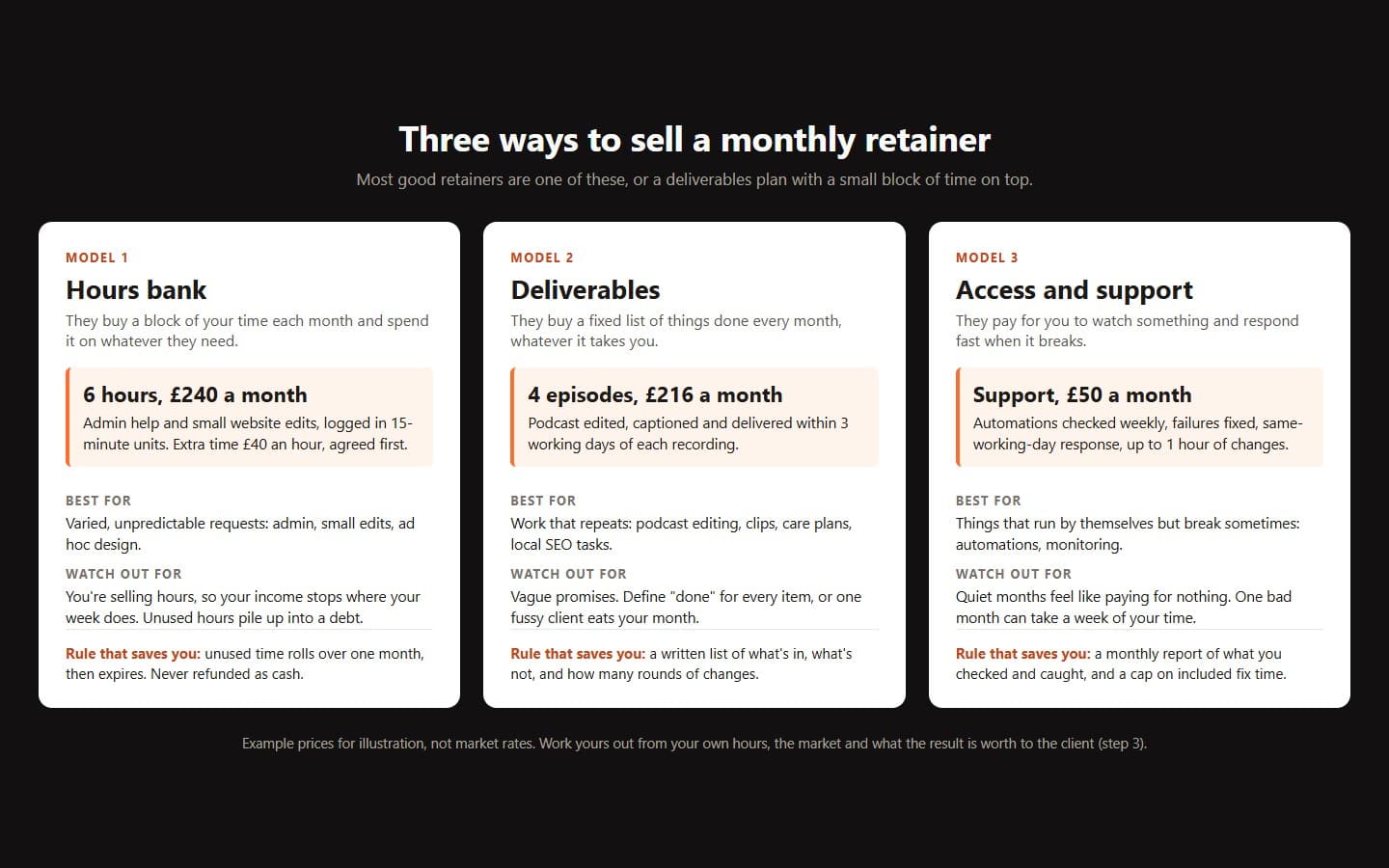
Step 3 shows how to work out your own prices. - Hours bank: they buy a block of time each month (say 6 hours) and spend it on whatever they need. Easy to sell and easy to understand. The trap: you're selling hours, so your income stops where your week does, and unused hours pile up into a debt if you let them roll over for ever. If it starts to look like a job (set hours, they direct how you work, you couldn't send anyone else), read gov.uk's signs of being self-employed ↗ and keep clearly on that side of the line.
- Deliverables: they buy a fixed list of things done every month, however long it takes you. Four edited episodes, twelve clips, a care plan's checks and report, a month of local SEO tasks. This is the model that rewards getting faster: the price stays the same while your time drops. The trap: vague promises. Every item needs a "done when".
- Access and support: they pay for you to watch something and respond fast when it breaks: automations, monitoring, a site's uptime. The trap: in quiet months it feels like paying for nothing, and one bad month can take a week of your time. A monthly report and a cap on included fix time handle both.
Which model fits each service on this site:
- [Website care](/learn/website-care-plan): deliverables (checks, updates, backups, a report) plus a small block of change time.
- [Website monitoring](/learn/sell-website-monitoring): access and support. Small on its own, so bundle it into care.
- Local SEO, using Audit any business's Google visibility: deliverables. A fixed monthly task list and a report, never a ranking promise.
- [Admin automation](/learn/automate-small-business-admin): access and support, with a little change time.
- [Podcast editing](/learn/podcast-editing-service) and short content clips: deliverables. A set number of episodes or clips a month, with a turnaround time. The editing itself is in Cut the silences out of any talking video and Subtitles for any video.
- General admin and "bits and pieces": an hours bank.
TipThe strongest retainers are usually deliverables with a small hours bank on top: the client knows exactly what they get every month, and the "could you just..." requests have somewhere to go.